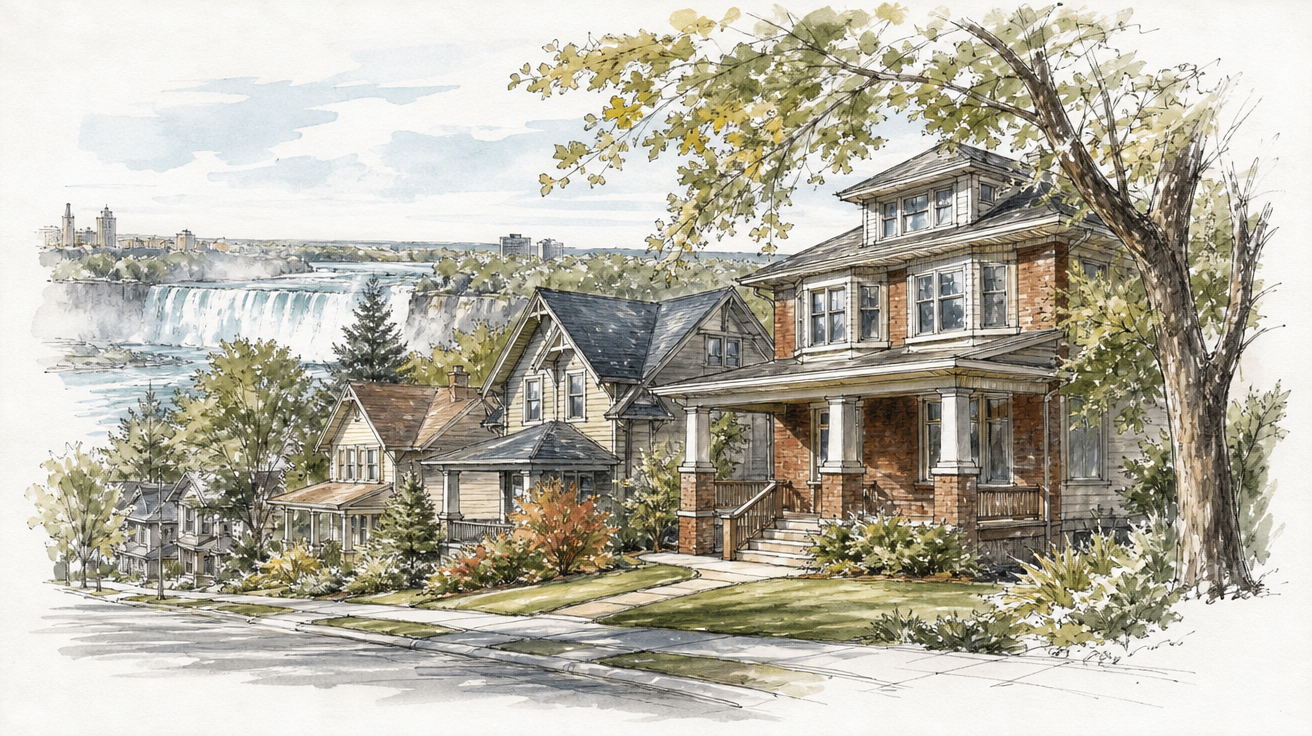
Relocation Services in Niagara Falls / Fort Erie: What Out-of-Town Buyers Need to Know Before Moving
Angela Brooks is a Real Estate Agent in Niagara Falls / Fort Erie, ON specializing in Relocation Services. Her work also extends across the broader Niagara region, supporting buyers who are relocating from other provinces, other parts of Ontario, or outside Canada entirely.
Many out-of-town buyers right now are stuck on a difficult question: buy now, or wait and risk losing the negotiating room they currently have? Local market conditions — price trends, how long homes are taking to sell, and how much choice is on the market — change how offers get written, how much flexibility a buyer has on conditions, and how quickly a relocation timeline can realistically move. For someone coordinating a move from out of town, that uncertainty is compounded by not knowing the local market well enough to judge whether to act now or wait.
Key Takeaways
- Current local conditions in Niagara Falls and Fort Erie — price trends, inventory and days on market — shape how much negotiating leverage a buyer has, so confirm up-to-date figures before deciding.
- Relocation Services covers far more than finding a home — it includes timeline coordination, remote due diligence, and local logistics that out-of-town buyers cannot easily manage alone.
- Mortgage qualification concerns are valid even when prices are lower; affordability depends on income documentation and debt ratios, not price alone.
- Ontario real estate transactions are regulated by RECO under TRESA, which sets consumer protection standards buyers should understand before relocating.
- A structured relocation plan reduces the risk of rushed decisions driven by distance and unfamiliarity with the local market.
What Does Relocation Services Actually Involve for an Out-of-Town Buyer?
Relocation Services means coordinating a home purchase for a buyer who is not physically local to the market, which requires remote property evaluation, timeline alignment with a move date, and local logistics support that a standard transaction does not. It is not simply showing homes to someone who happens to live elsewhere. A good Relocation Services plan treats the out-of-town buyer's distance as the central planning constraint rather than an afterthought. In a market like Niagara Falls / Fort Erie, where buyers are often arriving from considerable distances, this planning discipline tends to matter more than it would in a market people already know well.
For a buyer moving to Niagara Falls or Fort Erie from another city or province, the process typically starts well before a property is identified. It includes establishing a realistic search radius, understanding commute patterns if employment is tied to the Greater Toronto Area or the U.S. border crossing, and building a shortlist based on video walkthroughs and detailed condition reports rather than in-person visits alone.
A second layer involves coordinating closing timelines with a physical move — packing, employment start dates, school enrollment deadlines, and sometimes bridging between a sale in another market and a purchase here. Relocation Services also means flagging local conditions a non-resident would not know to ask about, such as flood zones near the Niagara River, well and septic considerations in parts of Fort Erie, or short-term rental restrictions that affect investment intentions. These are the kinds of details a local real estate agent surfaces as a matter of course, but they are easy for an out-of-town buyer to miss without that guidance.
In Ontario, real estate salespersons and brokers are licensed and regulated by the Real Estate Council of Ontario (RECO) under the Trust in Real Estate Services Act (RECO, 2026), which means an out-of-town buyer working with a licensed real estate agent in this market has access to standardized consumer protections regardless of where they are relocating from.
Should an Out-of-Town Buyer Purchase Now or Wait in This Market?
Whether to buy now in Niagara Falls / Fort Erie depends mostly on the buyer's own timeline and financial readiness, while current local conditions — recent price trends, inventory and days on market — determine how much room a buyer has to negotiate on price, conditions, and closing dates. Relocating buyers should ask a local real estate agent such as Angela Brooks for up-to-date local figures before deciding, because there is no single correct answer for every situation.
Waiting carries its own risk: if market conditions tighten before a buyer is ready to act, the negotiating room available today may not persist. Buying now carries the risk that values could soften further before stabilizing. Neither outcome can be predicted with certainty, and a decision should be grounded in the buyer's own timeline and financial readiness rather than an attempt to time the bottom of the market.
For relocating buyers specifically, timing is often driven by external factors — a job start date, a lease expiration, a school year — that matter more than squeezing out additional negotiating leverage. A buyer with a fixed move date in three months has a different calculus than one with an open-ended timeline.
At the national level, the non-seasonally adjusted average home price was $668,219 in August 2026, up 0.6% from the same month a year earlier (CREA, 2026), which is a reminder that conditions in Niagara Falls and Fort Erie and national averages can move independently. A buyer relocating from a market with different dynamics should not assume national trends apply locally.
How Does Mortgage Qualification Work for Someone Relocating to This Market?
Mortgage qualification for a relocating buyer depends primarily on documented income, existing debt obligations, and down payment size — not on where the buyer is currently living. Lenders generally require proof of employment or income continuity, particularly when a job transfer or remote-work arrangement is part of the relocation.
A lower purchase price in today's market does not automatically mean easier qualification. Household debt levels still factor heavily into lender calculations, and even with the Canadian household debt-to-disposable-income ratio declining from 189.3% in Q1 2024 to 184.6% in Q1 2025 (FSRA, 2025), individual household affordability still varies widely and that broader trend does not guarantee any single buyer's qualification outcome.
Buyers relocating with a pending sale in another market, a new employment contract, or self-employment income often need additional documentation. For current rate information specific to a relocation scenario, speak with a mortgage professional or your lender, since rate figures change frequently and should come from a current source rather than a published article.
What Does the Remote Home Search Process Look Like in Practice?
A remote home search works best when it is structured around pre-screened listings, detailed video walkthroughs, and a trusted local contact who can attend showings on the buyer's behalf before a final decision trip. This reduces wasted travel and narrows the shortlist before the buyer ever sets foot in the market.
Consider a scenario where a family relocating from outside the province has a six-week window between a job offer and a required start date. In a situation like this, the search typically begins with a detailed conversation about must-haves versus flexible preferences, followed by a curated shortlist of three to five properties reviewed through video and photo documentation before any in-person visit is scheduled.
A common pattern that causes problems is when out-of-town buyers rely solely on listing photos and square footage figures without a local party verifying condition issues — older roofing, foundation concerns near the Niagara River corridor, or deferred maintenance that photos do not reveal. The standard home inspection period in Ontario offers one structural safeguard, typically built into an agreement of purchase and sale as a negotiated condition period, giving buyers a window to have a licensed inspector assess the property before the deal becomes firm.
The reframe that applies broadly: distance does not have to mean reduced due diligence, provided the process is structured deliberately rather than compressed into a single rushed weekend trip.
How Do Closing Timelines Work When Coordinating a Long-Distance Move?
Closing timelines for relocating buyers should be built backward from the actual move date, with buffer time built in for financing approval, inspection conditions, and unexpected delays. Closing dates in Ontario are negotiated between buyer and seller as part of the agreement of purchase and sale, and the right timeline depends on both parties' circumstances.
For someone relocating under a tight employment start date, a 30-day closing may sound appealing but leaves little room for financing or inspection contingencies to be resolved without pressure. A 60-day closing provides more breathing room but requires temporary housing or storage planning if the buyer's departure from their previous location happens sooner.
Bridge financing is sometimes used when a buyer's current home sale has not yet closed but the new purchase needs to proceed on a fixed date; this is a lending product with its own qualification requirements, and buyers should discuss specifics with a mortgage professional or their lender directly.
A practical consideration specific to this market: closing dates that fall near major holiday periods or peak tourist season in Niagara Falls can affect the availability of movers, inspectors, and service providers, so scheduling flexibility matters more here than in markets without seasonal tourism pressure.
What Should Out-of-Town Buyers Know About Local Housing Supply?
Housing supply conditions directly affect how much selection a relocating buyer will have and how quickly they may need to act once a suitable property is identified. Supply has been constrained in several Canadian markets, which can narrow the realistic timeline for a remote search.
At the national level, condo starts in 2025 reached lows not seen since the 1990s (Bank of Canada, 2026), reflecting a broader pullback in new construction activity that has implications for resale inventory pressure in secondary markets like Niagara Falls and Fort Erie, even though this figure is a national rather than a local statistic. Housing starts data separately shows a year-to-date total of 149,542 units, down 4% from the same period in 2025 (CMHC, 2026), reinforcing that new supply has been trending downward broadly across the country.
For a relocating buyer, constrained new construction means resale inventory carries more weight in the search, and a well-maintained resale property in a desirable Niagara Falls or Fort Erie neighbourhood may receive more attention than it would in a market flush with new construction alternatives. This is one more reason a structured, pre-planned search matters more than an ad hoc approach for someone unfamiliar with local inventory patterns. It also means buyers relying on Relocation Services should expect to move decisively once a well-priced resale property matching their criteria appears, rather than assuming a comparable option will surface later in the search.
How Does First-Time Buyer Status Affect a Relocation Purchase?
First-time buyer status can affect affordability and eligibility for certain rebate and incentive programs, but it does not change the fundamental mortgage qualification process. A relocating buyer who has never owned property before should confirm program eligibility early, since documentation requirements can take time to assemble from outside the market.
Affordability challenges facing first-time buyers are not unique to any one city. Statistics Canada reports that while a larger share of households were first-time homebuyers in 2024, the share of first-time buyers living in unaffordable housing increased from 24.9% in 2018 to 27.4% in 2024 (Statistics Canada, 2026), a trend reflecting national conditions that individual buyers should weigh against their own specific financial circumstances rather than treat as a predictor of their personal outcome.
Government rebate and incentive programs for new construction change from year to year and carry their own eligibility rules and price thresholds, so a relocating first-time buyer considering a new build should confirm what currently applies directly with a tax advisor or the relevant government program office before comparing new builds with resale homes.
What Are the Most Common Mistakes Out-of-Town Buyers Make?
The most common mistake relocating buyers make is underestimating how local-specific factors — flood risk, seasonal tourism impact, cross-border proximity — affect property value and livability in ways a generic national search tool cannot capture. A second common mistake is compressing the entire search and purchase into a single short visit.
A situation like this often looks like a buyer arriving for a three-day weekend trip, viewing eight to ten properties back-to-back, and making an offer under time pressure before fully understanding neighbourhood-level differences between, for example, Fort Erie's waterfront areas and inland Niagara Falls neighbourhoods closer to the tourist core. The standard system fails here not because of bad intentions but because compressed timelines leave no room for the kind of local knowledge that only comes from living in or regularly working within a market.
A structured relocation approach identifies the real path by separating the research phase from the decision phase — reviewing properties remotely over several weeks before the in-person trip, so the in-person visit is used to confirm shortlisted choices rather than to conduct the entire search from scratch.
The outcome of this kind of structured approach is generally a buyer who arrives with a narrowed list and leaves with more confidence in their final decision, rather than second-guessing a rushed choice. The broader truth here: thorough preparation before travel tends to matter more than the number of days spent physically touring homes.
How Should a Relocating Buyer Think About Neighbourhood Selection?
Neighbourhood selection should be based on daily-life factors — commute routes, proximity to amenities, school catchments, and flood or environmental risk zones — rather than general impressions of a city's reputation. Niagara Falls and Fort Erie each contain distinct micro-markets that behave differently from one another.
Fort Erie's proximity to the Peace Bridge crossing makes it attractive to buyers with regular cross-border travel needs, while areas of Niagara Falls closer to the tourist district carry different noise, traffic, and short-term rental dynamics than quieter residential pockets further from the falls themselves. A relocating buyer unfamiliar with these distinctions can end up in a neighbourhood that technically matches their budget but does not match their lifestyle.
Flood-related risk is a specific local consideration worth raising directly: properties near the Niagara River or other low-lying areas may carry higher insurance costs or require additional due diligence regarding basement water history. A standard home inspection, combined with a request for seller disclosure on past water damage, forms the baseline due diligence step every buyer — local or relocating — should complete before waiving conditions.
Working with a local resource familiar with these micro-market distinctions, such as information available through Angela Brooks's website or her Google Business Profile, can help a relocating buyer narrow a search more efficiently than relying solely on generic listing portals.
What Ongoing Support Do Relocating Buyers Need After Closing?
Support needs after closing typically include settling-in logistics — utility transfers, local service provider connections, and understanding municipal requirements — that extend beyond the transaction itself. Relocation Services, done well, does not end at closing day.
For buyers moving from outside Ontario or outside Canada entirely, post-closing needs can include navigating municipal property tax registration timelines, understanding local utility providers, and connecting with service providers for move-related logistics like landscaping, snow removal, or home maintenance that may work differently than in their previous location. Buyers who treat this phase as part of the same Relocation Services plan tend to settle in with fewer surprises than those who treat closing day as the finish line.
A mortgage renewal cycle is also worth understanding early, even if it is years away. The Canada Mortgage and Housing Corporation's 2025 Mortgage Consumer Survey found that 65% of Canadians who completed a mortgage transaction in the prior 18 months were renewing an existing mortgage, compared with 12% who were first-time homebuyers (CMHC, 2025), a reminder that the mortgage process does not end at the initial closing and that renewal terms deserve attention well before they come due.
Staying connected to local market information after a move — through resources like a LinkedIn profile or an ongoing relationship with a local real estate professional such as Angela Brooks — can help a relocated buyer make informed decisions if they later consider refinancing, renovating, or eventually selling.
FAQ
Is now a good time to buy in Niagara Falls or Fort Erie, or should I wait?
There is no universal answer, since the right timing depends on your own timeline and financial readiness as well as current local conditions such as price trends, inventory, and days on market. Waiting risks losing negotiating leverage if conditions tighten, while buying now carries the risk that values could soften further. Ask a local real estate agent for current figures rather than trying to predict the exact bottom of the market.
Will I still qualify for a mortgage if prices are lower but my household expenses have gone up?
Qualification depends on documented income, existing debt obligations, and down payment size, not on the purchase price alone. A lower price does not automatically offset higher household costs in a lender's calculation, so it's worth reviewing your full financial picture, including any recent changes to income or expenses, before assuming affordability has improved. A mortgage professional can walk through current qualification requirements based on your specific documentation.
What happens if my current home hasn't sold yet but I need to close on a new one here?
This situation typically involves bridge financing or a carefully negotiated closing timeline that accounts for both transactions. It requires coordination between your current sale and your new purchase, and the details depend on your lender's specific requirements, so this is worth discussing directly with a mortgage professional early in the process.
Can I buy a home here without visiting in person first?
It is possible through video walkthroughs, detailed condition reports, and a local contact who can attend showings on your behalf, but most buyers still complete at least one in-person visit before finalizing a purchase. A structured remote search that narrows the list before travel tends to make that final visit more productive.
How long does closing typically take once an offer is accepted?
Closing timelines are negotiated between buyer and seller as part of the agreement of purchase and sale, and can be adjusted based on financing timelines, inspection conditions, and the buyer's move schedule. Relocating buyers should build in buffer time for unexpected delays rather than planning around the shortest possible timeline.
Are there flood or water-damage risks I should know about before buying near the Niagara River?
Some properties near the Niagara River or other low-lying areas carry higher flood risk, which can affect insurance costs and should prompt additional due diligence on past water damage history. A standard home inspection combined with seller disclosure requests on prior water issues forms a baseline due diligence step for any property in these areas.
Do first-time buyer programs still apply if I'm relocating from another province?
First-time buyer eligibility is generally based on your prior ownership history rather than your current location, but program-specific rules vary and should be confirmed directly with the relevant government office or a tax advisor. Some provincial incentives, including rebate programs on new construction, have specific purchase price thresholds and eligibility criteria worth reviewing early in your relocation planning.
What local factors should I research before choosing a neighbourhood in this area?
Commute routes, proximity to amenities, flood risk zones, and the difference between tourist-district areas and quieter residential pockets all affect day-to-day livability in Niagara Falls and Fort Erie. These factors vary significantly within short distances in this region, so relying on general city reputation alone can lead to a mismatch between your budget and your lifestyle expectations.